The Struggle for Secession, 1966-1970 by Ntieyong U. Akpan
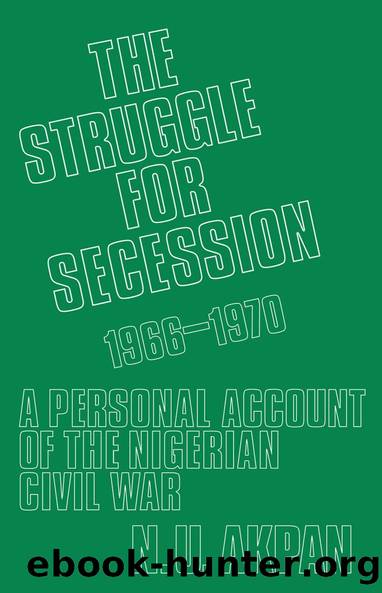
Author:Ntieyong U. Akpan [Akpan, Ntieyong U.]
Language: eng
Format: epub
Tags: History, General
ISBN: 9780714629308
Google: ysKRAAAAIAAJ
Publisher: F. Cass
Published: 1972-01-15T16:01:56+00:00
9 Internal Tensions and the Ahiara Declaration
We have already seen how certain extremist elements in Eastern Nigeria had exploited the crisis and the injured feelings of the people for ends other than those they professed. Among those extremists were intellectuals obsessed with their own personal ideological ideas and doctrines. The Governor had for his part exploited the enthusiasm and zeal of these elements to his own ends. In spite of the intelligence network, and the forces of fear, terror and intimidation operating within Biafra, the activities and aims of the extremists had not been destroyed. All that happened was a change of tactics and the adoption of different methods and guises. The behaviour and abuses by public functionaries and agents close to the Governor and the tension and simmering discontent which these and the strains of the war produced, were ready weapons in the hands of the activists.
Their basic tactic was the usual one of idealising and idolising an individual whom they would use as a front to achieve their ends, after which he could easily be disposed of. That individual, in the case of Biafra, was found in Governor Ojukwu, whose weaknesses and idiosyncracies they exploited to the full. They were mainly intellectuals and professionals, now unable to practise their respective professions, and devoting their talents and expertise to the war effort. A good number of these people were concentrated in the directorate of propaganda, which was later fused with the Ministry of Information but never really lost its separate identity. They could not have chosen a better base from which to operate. A good number of the leading elements in the âprogressiveâ and ârevolutionaryâ elite had been known agitators during the preindependence period, or had been trained in communist countries, or were former associates of extremist or leftist movements at one time or another. They were not all concentrated in the directorate of propaganda, but could be found in other war effort establishments such as research and production, commonly known as R.A.P. or R. and P.; they could also be found in the ordinary establishments of Government, such as the civil service.
For a long time, particularly after August 1966, the Governor had leaned considerably upon the intellectuals and professionals who had wormed themselves into his confidence. These arrogant so-called intellectuals, now finding themselves respected and admired by the Governor, exhibited open contempt and undisguised hostility towards the civil service and other branches of the public services. Even though their ignorance and naïveté in their approach to public affairs and problems were often obvious and sometimes appalling, they paraded themselves as the repositories of all knowledge, as lexicons with answers to all human problems. They saw scarcely any good in the existing order of institutions of public administrationâthe civil service, the police, the judiciaryâwhich they considered as either bad in themselves or badly organised and manned. Top civil servants were often openly insulted and despised, until it reached a stage when I had to intervene as the head of
Download
This site does not store any files on its server. We only index and link to content provided by other sites. Please contact the content providers to delete copyright contents if any and email us, we'll remove relevant links or contents immediately.
The Vikings: Conquering England, France, and Ireland by Wernick Robert(84423)
Ali Pasha, Lion of Ioannina by Eugenia Russell & Eugenia Russell(40336)
The Conquerors (The Winning of America Series Book 3) by Eckert Allan W(38067)
The Vikings: Discoverers of a New World by Wernick Robert(37024)
Cecilia; Or, Memoirs of an Heiress — Volume 1 by Fanny Burney(32654)
Cecilia; Or, Memoirs of an Heiress — Volume 2 by Fanny Burney(32025)
Cecilia; Or, Memoirs of an Heiress — Volume 3 by Fanny Burney(32005)
Empire of the Sikhs by Patwant Singh(23150)
The Secret History by Donna Tartt(19354)
Hans Sturm: A Soldier's Odyssey on the Eastern Front by Gordon Williamson(18665)
Cat's cradle by Kurt Vonnegut(15468)
Pimp by Iceberg Slim(14713)
Sapiens: A Brief History of Humankind by Yuval Noah Harari(14481)
Norse Mythology by Gaiman Neil(13474)
Talking to Strangers by Malcolm Gladwell(13474)
Leonardo da Vinci by Walter Isaacson(13427)
4 3 2 1: A Novel by Paul Auster(12544)
Underground: A Human History of the Worlds Beneath Our Feet by Will Hunt(12172)
The Radium Girls by Kate Moore(12119)
